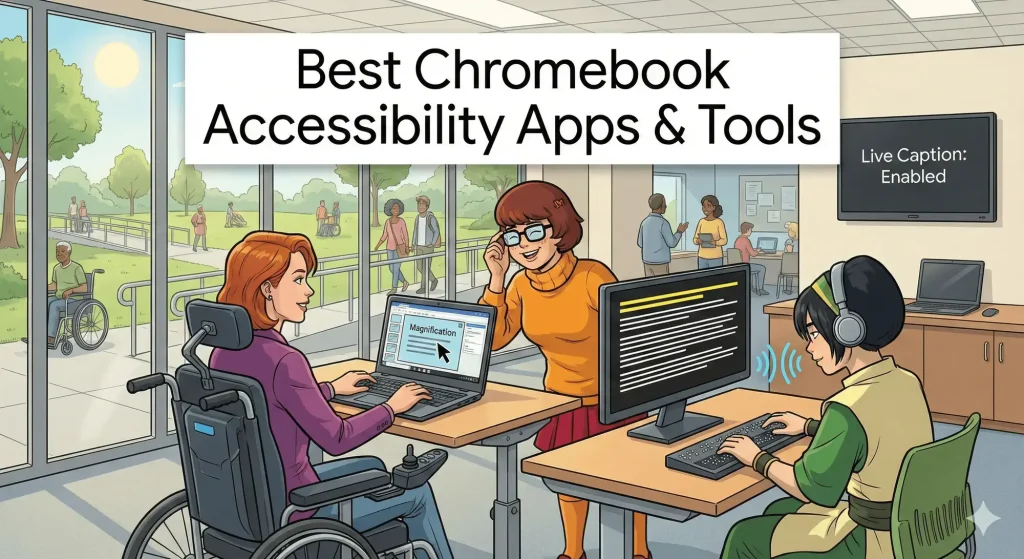
15 Best Chromebook Accessibility Apps & Tools (2026 Guide)
 by
Gloria Brown
January 23, 2026
by
Gloria Brown
January 23, 2026
Readers like you help support this site. When you make a purchase using links on our site, we may earn an affiliate commission. All opinions remain our own.
Quick Summary:
- Best for Hands-Free Control: ChromeOS Face Control
- Best for Reading Support: Read&Write for Google Chrome
- Best for Vision & AI: ChromeVox with Gemini
The best accessibility apps for Chromebook in 2026 include ChromeOS Face Control for hands-free navigation, Read&Write for literacy support, and the new AI-powered ChromeVox. But the biggest change this year is that you might not even need to download an app or extension at all.
The ecosystem has moved to a “Shift Left” model. This means the advanced features that used to be sold as expensive extras are now built directly into the operating system.
With the release of ChromeOS 144, your device uses on-device Gemini AI to act as a smart assistant. It can summarize messy text, describe images for blind users, and control the mouse using only facial gestures.
Below is our definitive guide to the 15 best tools and chrome extensions. If you have specific needs or feedback, you can contact us directly or leave a comment below.
🛠️ Native ChromeOS Features (Start Here)
In 2026, the built-in tools are robust enough to replace many paid apps. Always check these settings first.
1. ChromeOS Face Control
Native (Built-in)
The Problem: You cannot use a physical mouse or trackpad due to motor challenges like muscular dystrophy, cerebral palsy, or spinal cord injuries.
The Solution: Formerly “Project Gameface,” this feature is now built into every Chromebook. It uses your webcam to scan 468 points on your face. You can move the cursor by turning your head and click by smiling or raising your eyebrows. It even includes “smoothing” to stop the cursor from shaking.
Why we chose it: It works system-wide (even on login screens) and requires no expensive eye-tracking cameras.
2. ChromeVox & Select-to-Speak
Native (Built-in)
The Problem: Teachers send scanned PDFs that are just “pictures” of text, which normal screen readers cannot read.
The Solution: The browser now has Optical Character Recognition (OCR) built-in. It automatically detects text inside images or bad scans and reads it aloud. It also uses new AI voices that sound natural and less robotic, reducing listening fatigue.
Why we chose it: It makes “invisible” text accessible automatically without needing third-party tools.
📚 Literacy & Math Power Tools
These are the essential extensions for students and professionals who need deeper support for reading, writing, and STEM.
5. Read&Write for Google Chrome
Freemium / Education License
The Problem: You struggle with dysgraphia or dyslexia, and standard spellcheckers cannot figure out what you are trying to type.
The Solution: This is now the “Super App” of education. In 2026, it absorbed the best features of Co:Writer and Snap&Read. It includes “Neuron” word prediction that guesses what you want to write based on your topic (like predicting “Tyrannosaurus” if you are writing about dinosaurs). It also handles phonetic spelling errors that other tools miss.
Why we chose it: It combines three major apps into one toolbar, making it the gold standard for schools.
👂 Hearing & Note-Taking Support
Never miss a word in class or a meeting with these smart transcription tools.
9. Otter.ai
Freemium
The Problem: You have an auditory processing disorder or hearing loss, making it hard to take notes while listening to a teacher.
The Solution: Otter provides real-time transcription for Zoom, Google Meet, and in-person lectures. The new “OtterPilot” feature automatically joins meetings to take notes for you, even if you are not there. You can also chat with the AI during class to ask questions like “What was the homework assignment mentioned 10 minutes ago?” without interrupting the teacher.
Why we chose it: It syncs audio with text so you can tap any word to hear what was said at that exact moment.
🎯 Focus & ADHD Management
For users with ADHD, staying on task is the hardest part. These tools help manage executive function.
11. StayFocusd
Free
The Problem: You impulsively open social media or YouTube when you should be working, and normal blockers are too easy to turn off.
The Solution: StayFocusd is famous for its “Nuclear Option.” This feature blocks distracting sites for a set time, and there is absolutely no way to cancel it once it starts. It also has a “Require Challenge” mode that forces you to complete a difficult typing test without a single error if you want to change your settings.
Why we chose it: It provides the strict external discipline that many users with ADHD need.
📊 Comparison: Which Reader is Best?
With so many text-to-speech tools, it can be hard to choose. Here is a quick breakdown based on your needs.
| Feature | Speechify | NaturalReader | Read&Write |
|---|---|---|---|
| Best For | ADHD & Speed Reading | University Research | K-12 & Dyslexia |
| Key Strength | Celebrity AI Voices | Handling PDFs | Writing Support |
| Cost | Expensive ($139/yr) | Moderate ($119/yr) | Free for Teachers |
| Offline? | Limited | Limited | Yes (Strong) |
Final Implementation Tips
- For Schools: With the merger of Texthelp and Don Johnston, you should move your “Co:Writer” users to the new “Read&Write” writing mode to save money.
- For Parents: Start with Forest (Gamified) before StayFocusd (Strict). Positive rewards usually work better for children with ADHD than punishment.
- Battery Warning: Extensions like Speechify use the cloud and can drain your battery fast. Use the native “Select-to-Speak” if you are away from a charger.
❓ Frequently Asked Questions
Common questions about using AI and accessibility tools on Chromebooks.
Do I need the internet for the new AI features?
It depends. Native tools like Select-to-Speak and Face Control work offline because they process data directly on your Chromebook. However, generative AI features like Gemini “Help Me Read” or Speechify’s Celebrity Voices require an active internet connection to process the text in the cloud.
Will these apps drain my battery?
Yes, some will. Cloud-based extensions like Speechify and Otter.ai use more power because they constantly transmit data. If you are low on battery and away from a charger, we recommend switching to the built-in ChromeVox or Select-to-Speak tools, which are much more energy-efficient.
Is “Face Control” private? Does Google see my face?
Yes, it is private. The Face Control (formerly Project Gameface) technology processes your facial gestures locally on your device’s processor. The video feed from your webcam is not sent to Google’s servers, ensuring your privacy is protected.
Can I use these tools on an older Chromebook?
Basic tools like Read&Write, StayFocusd, and standard screen readers work on almost any Chromebook. However, the new native AI features (like Gemini Nano and Face Control) require the ChromeOS 144 update or later. If your device is older than 2021, it may not support the advanced AI features.
Where can I get more help?
For technical support, we recommend these official resources:
- Google Accessibility Help Center (Official Manuals)
- r/ChromeOS Community (Ask real users)
- Google for Education Accessibility (For Teachers)
Read Next on Chrome Geek:
Discover more from Chrome Geek
Subscribe to get the latest posts sent to your email.