NYC, LA and Chicago Schools Weigh Dropping Google Search Over AI
 by
Sophie Sullivan
Post Updated: November 19, 2026
The three largest school districts in the US are thinking about dropping Google Search. New York City, Los Angeles and Chicago are looking at other search engines after Google said it will not offer schools a version of Search without its AI features, as The New York Times reported on November 18 (via The Seattle Times). The pushback lands on the company whose Chromebooks, Classroom and Docs run much of American education.
1. What started this
The all-or-nothing rule: earlier this month Google said Gemini, Gemini Notebook, Gemini in Classroom and Search will be off for K-12 student accounts until admins turn them on. We covered the details in our story on Google’s new school AI controls. The catch is that schools cannot keep Search while turning off the AI features. Chris Phillips, Google’s vice president of education, told the Times that “Search and AI are deeply integrated,” and that schools that turn off the AI “will not have access to Search.”
Why schools object: educators worry that AI answers in Search can hurt critical thinking and make cheating easy. Some students have used the chatbots inside search to cheat, or read AI summaries instead of the original documents, according to the Times.
2. What each district said
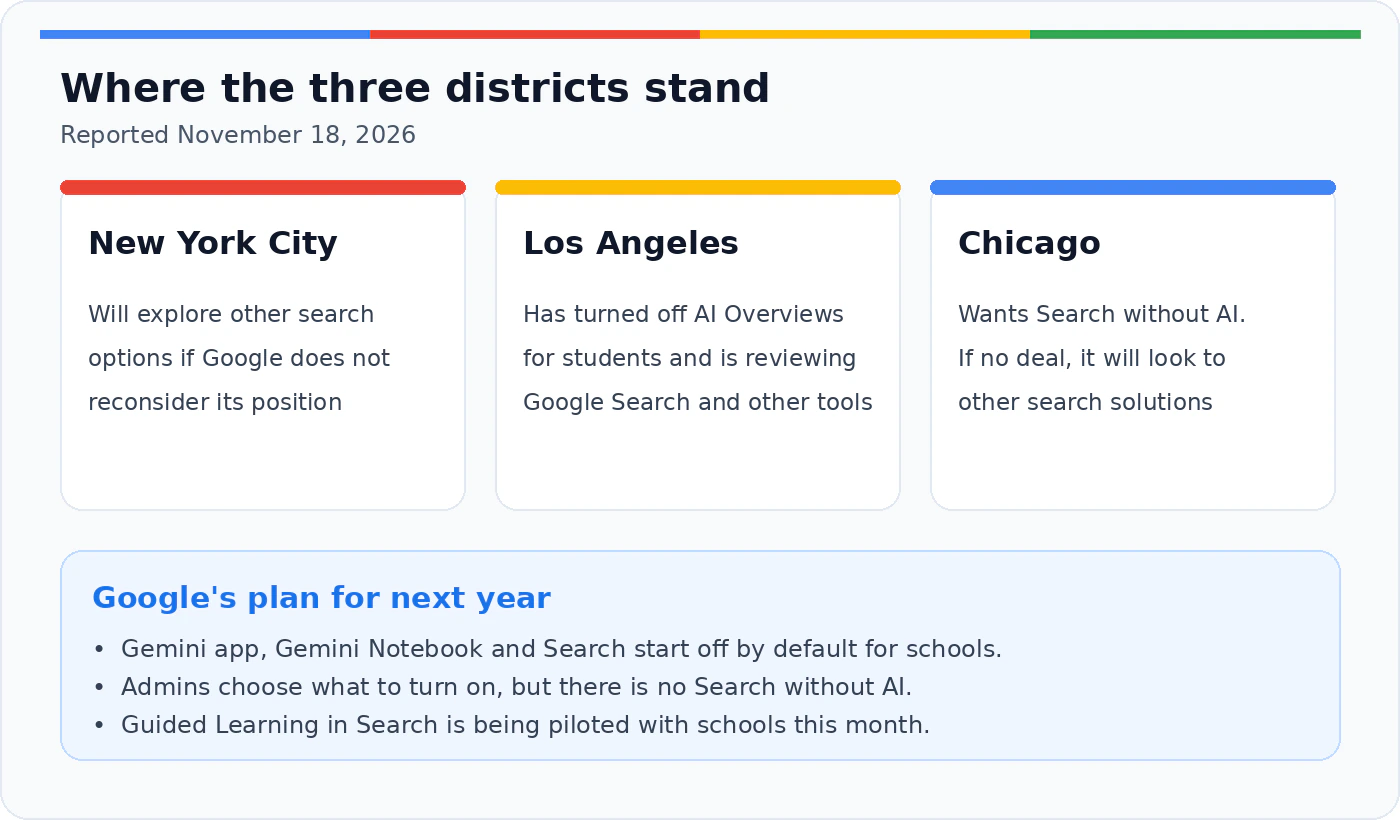
New York City: “If Google doesn’t reconsider their position, we will explore other search options,” said schools chancellor Kamar H. Samuels. “We refuse to accept the false binary Google has laid out.”
Chicago: Chicago Public Schools, the fourth-largest US school system, wants a version of Search without AI. “If such an arrangement can’t be reached,” the district said, “the district will look to other search solutions.”
Los Angeles: LAUSD told NBC Los Angeles that it has disabled Google’s AI Overviews for students and will “continue to evaluate” whether Google Search and other tools support learning.
Politicians too: as The Verge reports, New York City Mayor Zohran Mamdani and Senator Bernie Sanders both called Google’s approach “extortion.”
3. What Google says
Its statement: a Google spokesperson told The Verge that the company shares parents’ and teachers’ goal to “help students learn.” Google is starting a pilot of Guided Learning in Search this month, which walks students through problems step by step instead of handing over answers.
Off by default: Google repeated that next year, the Gemini app, Gemini Notebook and Search will be off by default until each school decides which services to enable. It did not say it would offer Search without AI.
4. What it means for school Chromebooks
Switching is possible: on managed Chromebooks, IT admins already choose the default search engine from the Google Admin console, and they can block sites they do not want students to use. So a district could make DuckDuckGo or Bing the default without replacing a single laptop. Both offer settings to turn off AI answers, according to the Times.
But not easy: schools rely on Google Classroom, Docs and Chromebooks every day, and The Verge notes that going fully Google-free “might prove difficult.” Swapping the search engine is the simple part. Retraining teachers and updating lessons built around Google Search takes longer.
For students and parents: nothing changes overnight. Your school’s IT team decides which search engine and which Google services a school account can use, so ask them about their plans.
Our take
Google built its school business on trust and simple controls, and an all-or-nothing switch for Search cuts against both. When the three biggest districts in the country push back together, Google will have to listen. One likely outcome is a school version of Search with the AI turned down, or a lot of school Chromebooks quietly switching search engines next year.
Discover more from Chrome Geek
Subscribe to get the latest posts sent to your email.