Gemini 4 Neon Is Now Rolling Out to AI Pro and Developers
 by
Sophie Sullivan
Post Updated: November 18, 2026
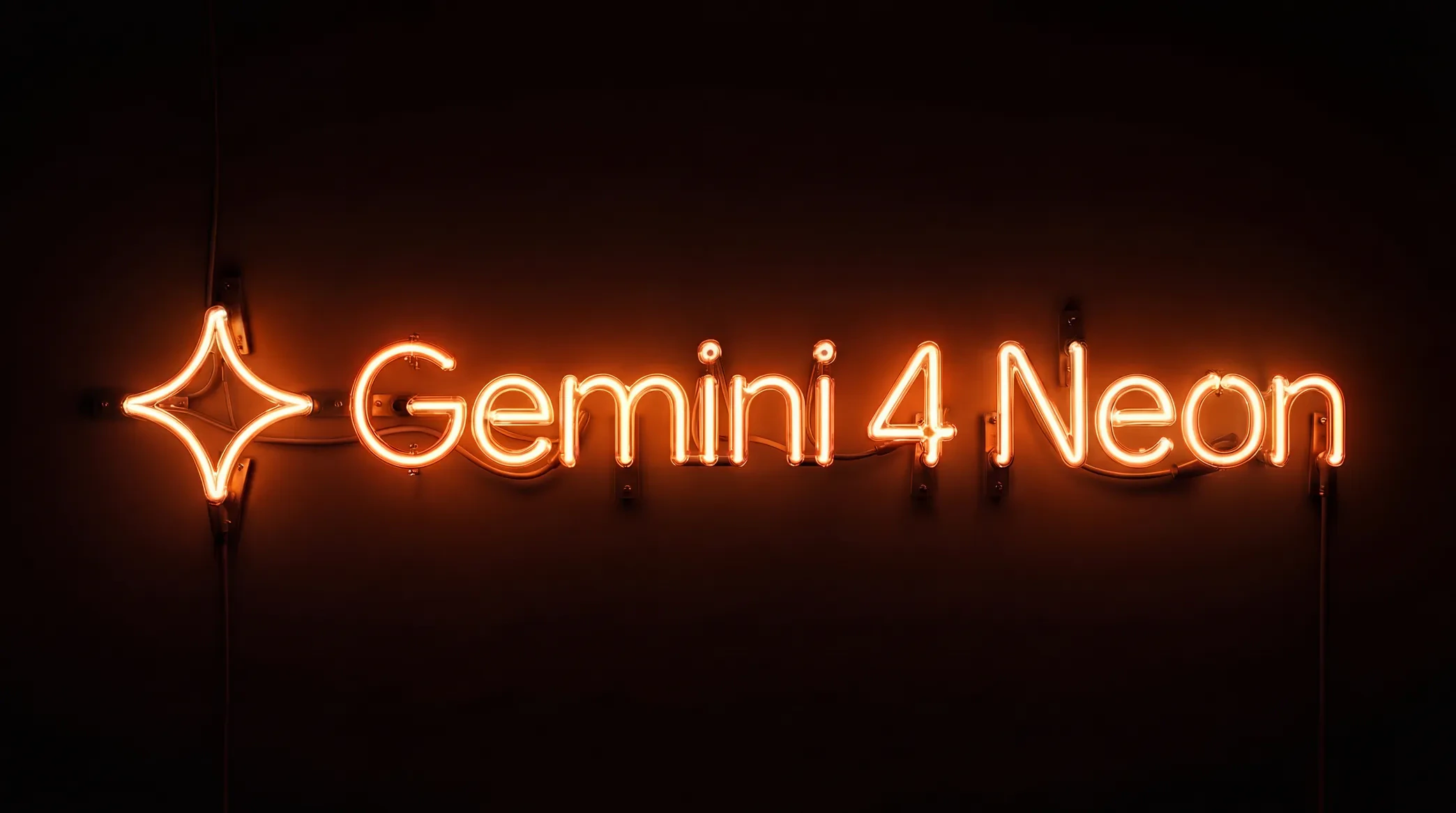
Google has launched Gemini 4 Neon, a new model in the Gemini 4 family for complex coding, knowledge work and science jobs that need strong reasoning at a faster, lower cost than its biggest model. It is rolling out today in the Gemini app and Google Antigravity for AI Pro and Ultra subscribers, and in the paid Gemini API. The details are in Google’s launch post. We have already seen Neon in the Gemini web app, the Gemini mobile app and Antigravity.
1. What Neon is
Google’s pitch: Neon brings frontier-level intelligence with faster end-to-end task completion for complex software engineering, knowledge work and science workflows. In Google’s words, Carbon still tackles the hardest, long-horizon projects, Hydrogen handles fast everyday execution, and Neon balances depth and efficiency.
Context and controls: Neon has a 1 million-token context window. Google is also refining thinking levels with this release, so teams can trade intelligence against token spend. The default is high. The xhigh setting is for deeper, multi-step reasoning on the hardest engineering, analytical and scientific work. 9to5Google lists the four levels as Low, Medium, High and Extra High, the same set as Hydrogen.
In the Gemini app: Google says Neon should write more clearly, read uploads such as spreadsheets, PDFs and photos more precisely, and pull in useful details from apps like Gmail and Docs. Tasks in Gemini can now run on Neon, which Google says is quicker and more efficient than using a larger model for those multi-step jobs.
2. Who can use it right now
In the Gemini web app: we already see the new picker on an AI Pro account. Auto is labelled “Adapts to your needs”, Everyday help is 4 Hydrogen, Deeper analysis is 4 Neon, and Code & complex work is 4 Carbon, which still shows a lock on that Pro account. That lock matches Google’s earlier Carbon rollout, which opened the Gemini app picker to AI Ultra. There is also a Thinking level control in the same menu. Neon is also showing up in the Gemini mobile app.
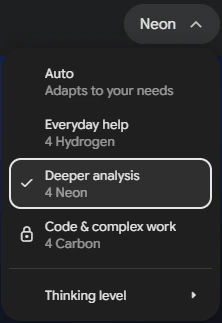
According to 9to5Google: this launch also removes Gemini 3.1 Pro from the app picker, replaces Argon there, and turns 3.5 Flash-Lite into Auto for paid users. Our screenshot matches that new four-row layout. Argon is not gone everywhere, though: it still appears in Antigravity, and it remains in the paid API.
In Google Antigravity: we already see Gemini 4 Neon Medium listed as new, along with Orchestrator (Neon). Google says Neon can run on its own or act as a fast Orchestrator that directs parallel Hydrogen subagents. In the same picker, Gemini 4 Carbon was listed as Unavailable.
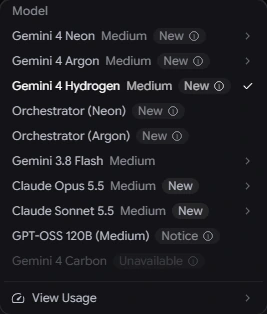
On a Chromebook or Googlebook: there is nothing extra to install. Open the Gemini web app, and if you are on AI Pro or Ultra, look for 4 Neon under Deeper analysis once the rollout reaches your account. Google’s launch post does not mention AI Mode in Search or a Chrome-only feature for Neon.
3. What it costs developers
How to read that table: Neon’s list price is twice Hydrogen’s paid rate, and it is not available on the free API tier. Until November 30, Carbon and Argon are still on promotional pricing of $2 in and $10 out, which is cheaper per token than Neon. After that promo ends, Neon is 25% cheaper per token than Carbon or Argon at the standard $4 and $20 rate.
Cost per task is a different claim: Google says that at Neon’s default high thinking level, it has a 32% lower cost per task than Carbon. It also says Neon sits on the Pareto frontier on the Vals Index and Agent Arena at high, with roughly 50% to 80% lower cost per task than the top competing frontier models, and that xhigh still costs 36% or more less per task than competing models at their highest setting. Those are Google’s figures, not a price list.
4. The benchmarks Google is highlighting
Headline scores: at its xhigh thinking level, Neon ranks third overall with a score of 61 on the Artificial Analysis Intelligence Index, just behind larger, slower models. On the Vals Index it ranks second, at 70.9%. Google also says it ranks second for steerability, meaning it adapts cleanly to mid-task corrections, on the new Agent Arena Index, where it debuts second globally with a score of 1336 across more than 4,200 real-world agent sessions.
Coding and agents: Google says Neon ranks first overall on the Artificial Analysis Coding Agent Index, at 58.6, with 65.2% on Terminal-Bench 4.1 and 46.2% on FrontierCode 2.0 at its default high setting. On SWE-sweep, it scores 12.8% on the mini-SWE harness and 39.0% in Google Antigravity, which Google calls a state-of-the-art result for that harness.
Knowledge work and science: Google puts Neon first on Zapier’s AutomationBench (56.3%) and Andon Labs’ Vending-Bench 2 ($16,843), and says it is best in class on Terminal-Bench Science (70.5%), RiemannBench (84.0%) and HLE-Diamond (71.3%). It also scores 73.5% on Chartography and 75.8% on Agents’ Last Exam v1.1. These are Google’s own picks, so treat them as a starting point rather than a final verdict.
Cyber defense: Google is also preparing a Neon for cyber variant for trusted defenders in its Fairwind Program, with access due in the coming days. Eligible teams should talk to their Cloud account team. We are not going to recap the security-benchmark claims in detail here.
Our take
For most AI Pro users, Neon looks like the practical step up when Hydrogen is not enough. Carbon remains the model Google reserves for the biggest, messiest jobs, and it is still locked in the Gemini app on an AI Pro account. Developers should weigh two clocks at once: Carbon and Argon are cheaper per token until November 30, but Google says Neon can cost less per finished task at its default high setting, and it becomes the cheaper list-price option after December 1.
Discover more from Chrome Geek
Subscribe to get the latest posts sent to your email.