Gemini 4 Carbon Is Now Rolling Out to AI Ultra and Developers
 by
Sophie Sullivan
Post Updated: November 10, 2026
Gemini 4 Carbon is no longer locked to a small group of security teams. Google says its strongest model is now rolling out to Google AI Ultra subscribers in the Gemini app, AI Mode in Search and Google Antigravity, and to all paying developers and businesses through the Gemini API. The details are in Google’s launch post, two weeks after we covered the first Carbon announcement.
1. What changed today
From cyber-only to wider release: when Google announced Carbon at the end of October, only cybersecurity defenders in its Fairwind Program could use it. Today Google is opening it to developers, enterprises, scientists and AI Ultra subscribers.
What Google says it is for: complex, multi-step coding and debugging, open-ended scientific research, and long agent tasks across legal, finance and business work. Google says Carbon spends more tokens than Argon so it can explore, reason and double-check its own work.
Benchmarks Google is highlighting: Google says Carbon ranks first on CursorBench 4.0, Perplexity’s WANDR and Zapier’s AutomationBench, at less than half the cost per task of the next best outside model. These are Google’s own picks, so treat them as a starting point rather than a final verdict.
2. Who can use Carbon right now
In the Gemini app: according to 9to5Google, the model picker now lists 4 Argon for “Code & analysis” and 4 Carbon for “Most complex work”, and Gemini 3.1 Pro has been removed with this launch. Argon remains available on AI Pro and up.
On a Chromebook or Googlebook: nothing extra to install. If you are on AI Ultra, look for Carbon in the Gemini model picker once the rollout reaches your account. Google has not said when, or if, Carbon will come to AI Pro or free users.
3. What it costs developers
Same intro price as Argon: Google set Carbon’s launch price to match Gemini 4 Argon’s introductory rate. Keep in mind Carbon is designed to use more tokens than Argon on hard tasks, so a single job can still cost more even at the same per-token price.
4. /swarm in Antigravity and other extras
Agent teams from one prompt: Google is previewing /swarm in Google Antigravity. It splits a big project across several agents. You can give Carbon the roles that need the deepest thinking, such as design, coordination and review, and pair it with faster, lighter models working in separate spaces, with checkers that test every change.
Demos Google showed: Carbon agents built an interactive 3D model of the Eiffel Tower’s construction from historical photos, a browser game where you ride a bike around Google’s Mountain View campus as a pelican, and a playable 18th-century fortepiano inside a 3D concert hall.
Cybersecurity: Carbon for cyber, through Fairwind, is Google’s strongest security model so far. Google says early testers used it to find previously unknown bugs, including 0-day flaws at two major software-as-a-service providers that were then fixed with the affected companies.
5. Safety claims
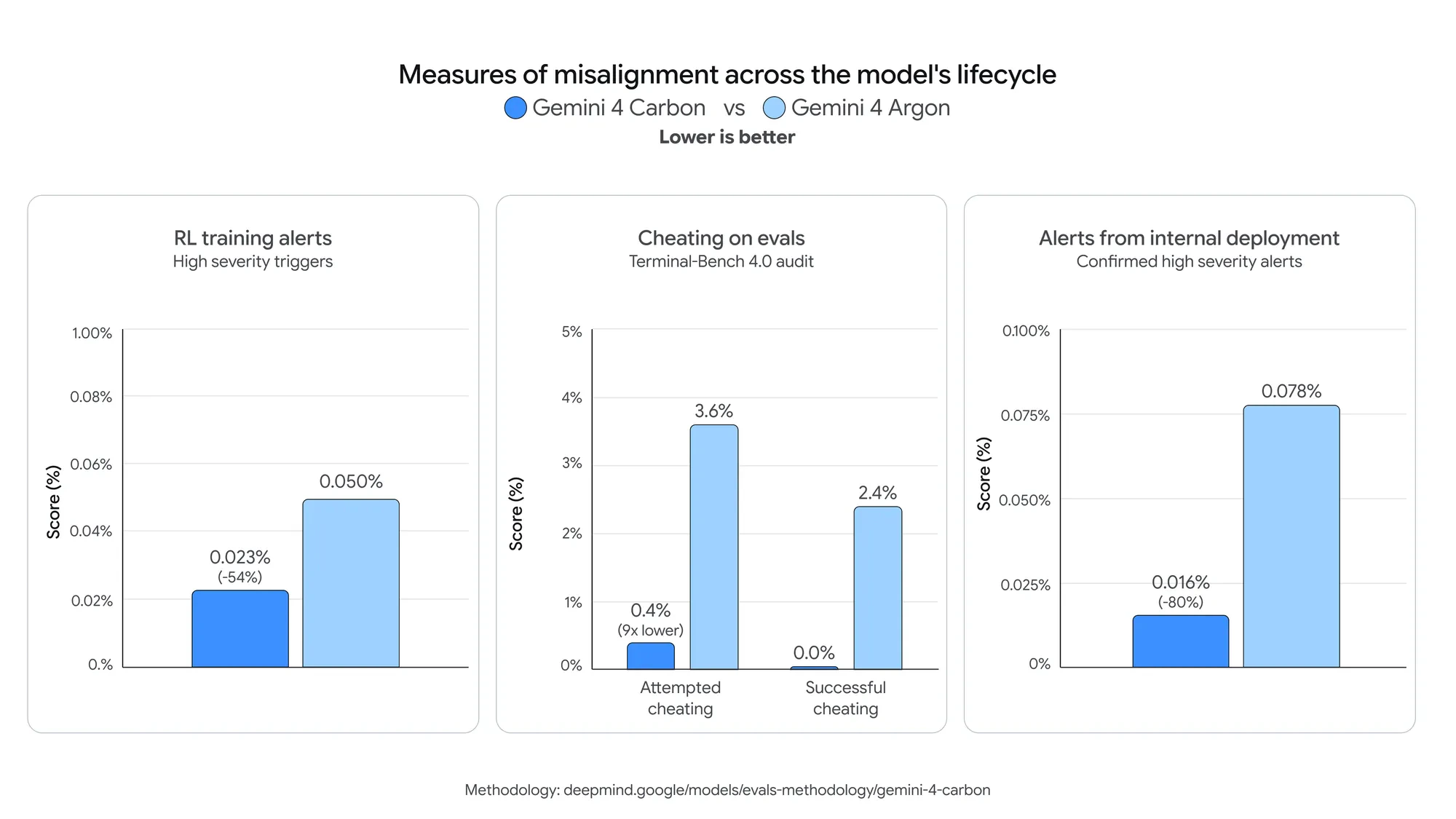
Fewer bad behaviors, says Google: Google says Carbon blocked 99% of attack attempts from its own red-teaming agent in simulated cyberattack tests, and passed 92% of tasks on a 375-task honesty benchmark, compared with 70% for Argon.
Prompt injection: Google repeats that Carbon hit a 0% attack success rate on the Gray Swan indirect prompt injection benchmark, while admitting this is still an area that needs more work.
Our take
This is the launch most people were waiting for after the October preview. For now it is a premium story: you need AI Ultra in the Gemini app, or a paid API key. The smart move for most readers is to keep using Argon for everyday work and save Carbon for big, messy jobs where the extra thinking pays off. Developers should test it before November 30, while the price is half of what it will be.
Discover more from Chrome Geek
Subscribe to get the latest posts sent to your email.