Google Announces Gemini 4 Carbon, Its New Top Model for Coding and Cyber Defense
 by
Sophie Sullivan
Post Updated: October 29, 2026
Google has announced Gemini 4 Carbon, its new frontier AI model, just two weeks after Gemini 4 Argon. In its announcement, Google calls Carbon its strongest model yet, with big gains in coding, long agent tasks and cybersecurity. There is one big catch: for now, only a small group of cyber defenders can use it.

1. What Gemini 4 Carbon is
The next step after Argon: Carbon builds on Gemini 4 Argon, which Google launched two weeks ago. Google says it improved the model across coding, agent tasks, science, full web app building and understanding images and other media, based on user feedback after the Argon launch.
Built for long jobs: Google says its own teams have seen Carbon “run for days”, pushing through dead ends on hard engineering work like finding the root cause of subtle bugs across large codebases and patching them.
Better at building websites: Carbon jumped 89 points on WebDev Arena, a public ranking for web development, and now sits at number four.
2. A big jump in security skills
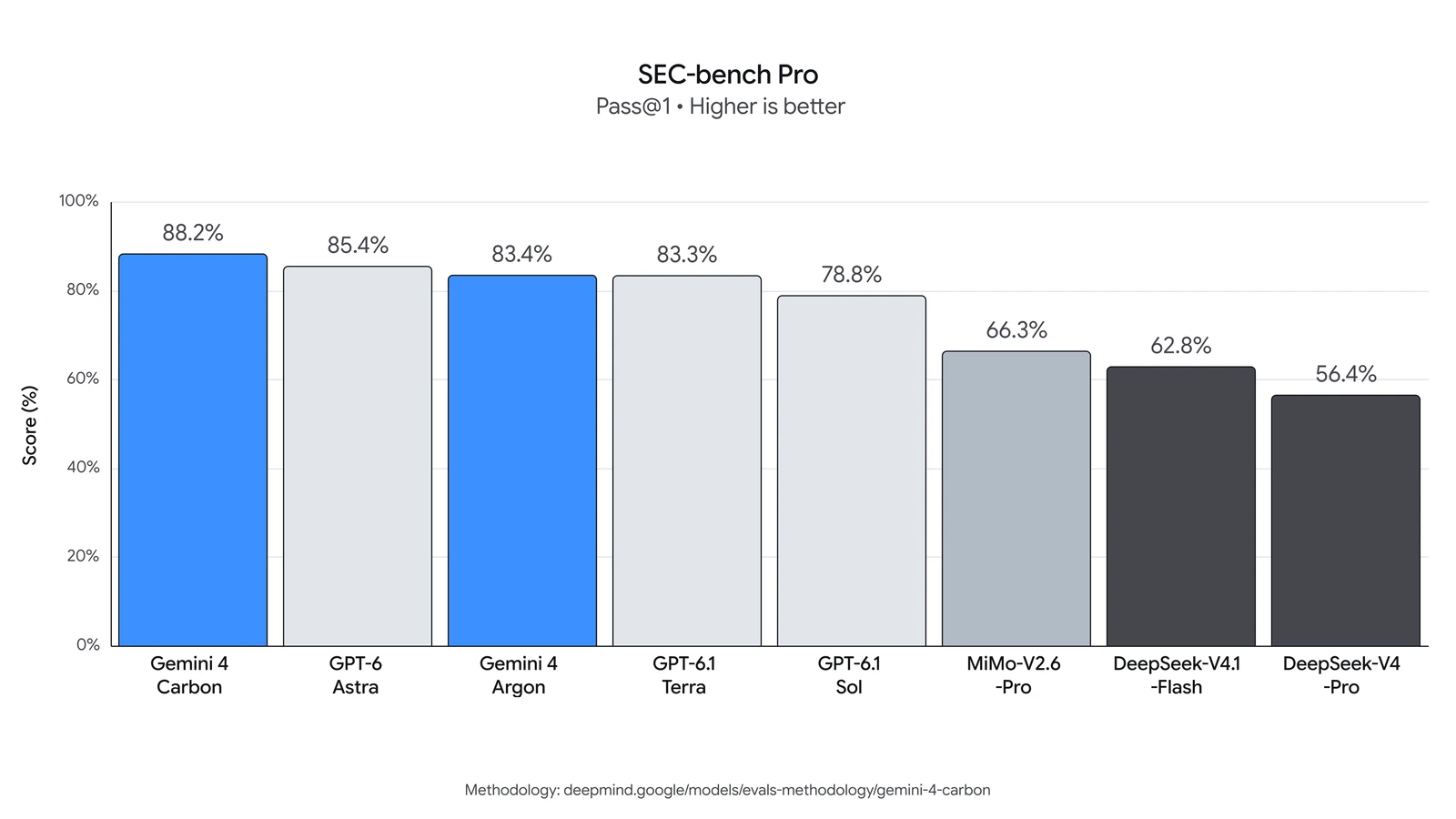
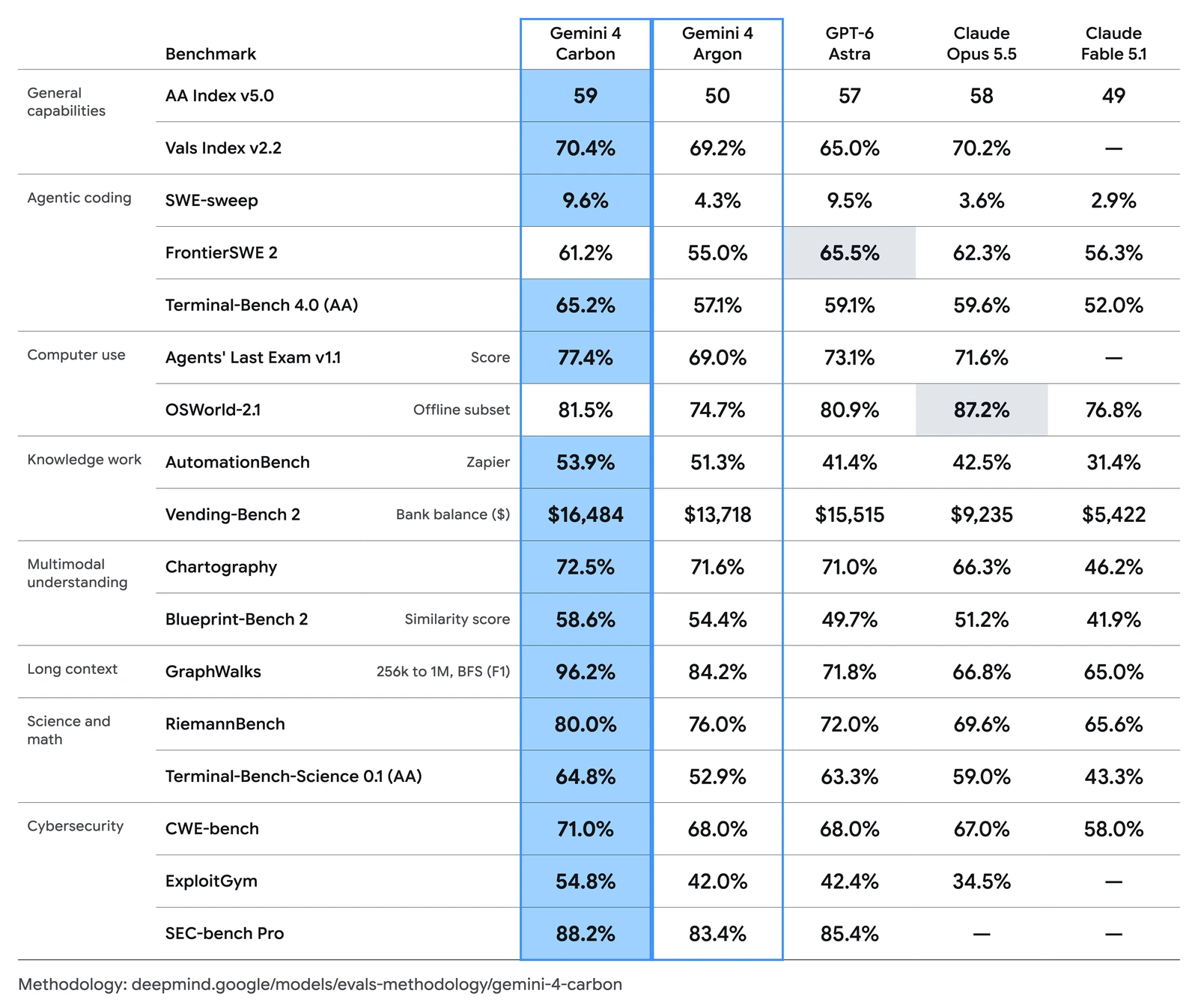
Find, test, fix: Google is pitching Carbon as a tool for defenders. It leads SEC-bench Pro at 88.2% for finding real bugs, ExploitGym at 54.8% for checking which bugs can actually be exploited, and CWE-bench at 71.0% for writing the fix. Google notes these scores were measured without its safety guardrails switched on.
A Chrome connection: Google says Carbon is more than twice as good as Argon at writing secure code on its internal tests, and the Chrome team found it did more than 10 times better than another lab’s large frontier model at writing high-quality patches. That matters for anyone using Chrome, as AI is now a big part of how browser bugs get found and fixed, as we saw with the recent Chrome 156 security update.
3. Carbon vs Argon in numbers
Here is how Carbon compares with Argon on a few of the tests Google shared. Higher is better on all of them.
Not a clean sweep: Google’s own chart shows rivals still ahead on a couple of tests. GPT-6 Astra wins FrontierSWE 2 and Claude Opus 5.5 wins OSWorld-2.1, a computer use test.
4. Safer and more honest, says Google
Fewer shortcuts: Google says Carbon cut successful cheating on Terminal-Bench 4.0 to 0.0%, and high-severity misalignment alerts in its live coding work dropped by almost 80%.
Fewer made-up claims: in Google’s testing, Carbon makes about half as many unsupported claims as Argon. It is also meant to flag gaps and ask you when something is unclear, instead of guessing.
Harder to trick: on Gray Swan’s indirect prompt injection test, where hidden text tries to hijack the AI, Carbon blocked every attack, down from a 0.7% success rate on Argon. That kind of resistance matters for AI agents that browse the web for you.
5. Who can use it, and what it costs
A slow, careful rollout: Google says it is taking part in the U.S. government’s voluntary pre-release testing. This week Carbon goes to a small group of cyber defenders, then to more trusted partners through the Fairwind Program, before reaching everyone else.
Price: when it opens up, Carbon will start at the same introductory price as Argon: $2 per million input tokens and $10 per million output tokens, with cached input 95% off. After the intro period it rises to $4 and $20.
Chromebook and Googlebook users: Google has not said which Gemini plans get Carbon first, or when it reaches Gemini in Chrome. As The Verge notes, it is only open to select security companies for now. Argon followed a similar path, so it is worth checking how the Argon rollout to Pro users played out.
Our take
Two frontier models in two weeks is a fast pace, even for Google. Carbon looks like a solid step up from Argon, especially for coding and security, and the Chrome team’s patching results are a nice real-world sign. But for most readers it is a model you can read about, not use. If you want to see what this generation of Gemini can already do, the Argon builder projects are a good taste. We will post again the moment Carbon reaches the Gemini app.
Waiting for Carbon? Here is how to use Gemini 4 Argon today on your Chromebook, Googlebook or in Chrome.
Discover more from Chrome Geek
Subscribe to get the latest posts sent to your email.