Google’s AI Satellite Sends Its First Answer From Space: a Haiku
 by
Sophie Sullivan
Post Updated: October 31, 2026
Google’s Project Suncatcher satellite has sent back its first AI answer from space, and it was a poem. In a post on Google’s Keyword blog on October 30, Google said it sent a prompt up to the satellite, a Google TPU (the chip Google builds to run AI) booted up in orbit, and its Gemma 4 model wrote a haiku that came back down to Earth. Google calls it a “Hello World” moment: the first AI response from a data center class TPU in orbit.
1. What happened up there
The launch: Google launched the prototype satellite on October 1. It spent the next few weeks working through its setup checklist, which included powering up the computer trays that hold the TPUs and running early machine learning tests.
The first prompt: during a pass over a ground station, Google sent a prompt to Gemma 4, the open AI model loaded on the satellite, asking it to write a haiku about being in space.
The reply: the answer came back as the satellite passed over Svalbard, Norway. Here it is, word for word:
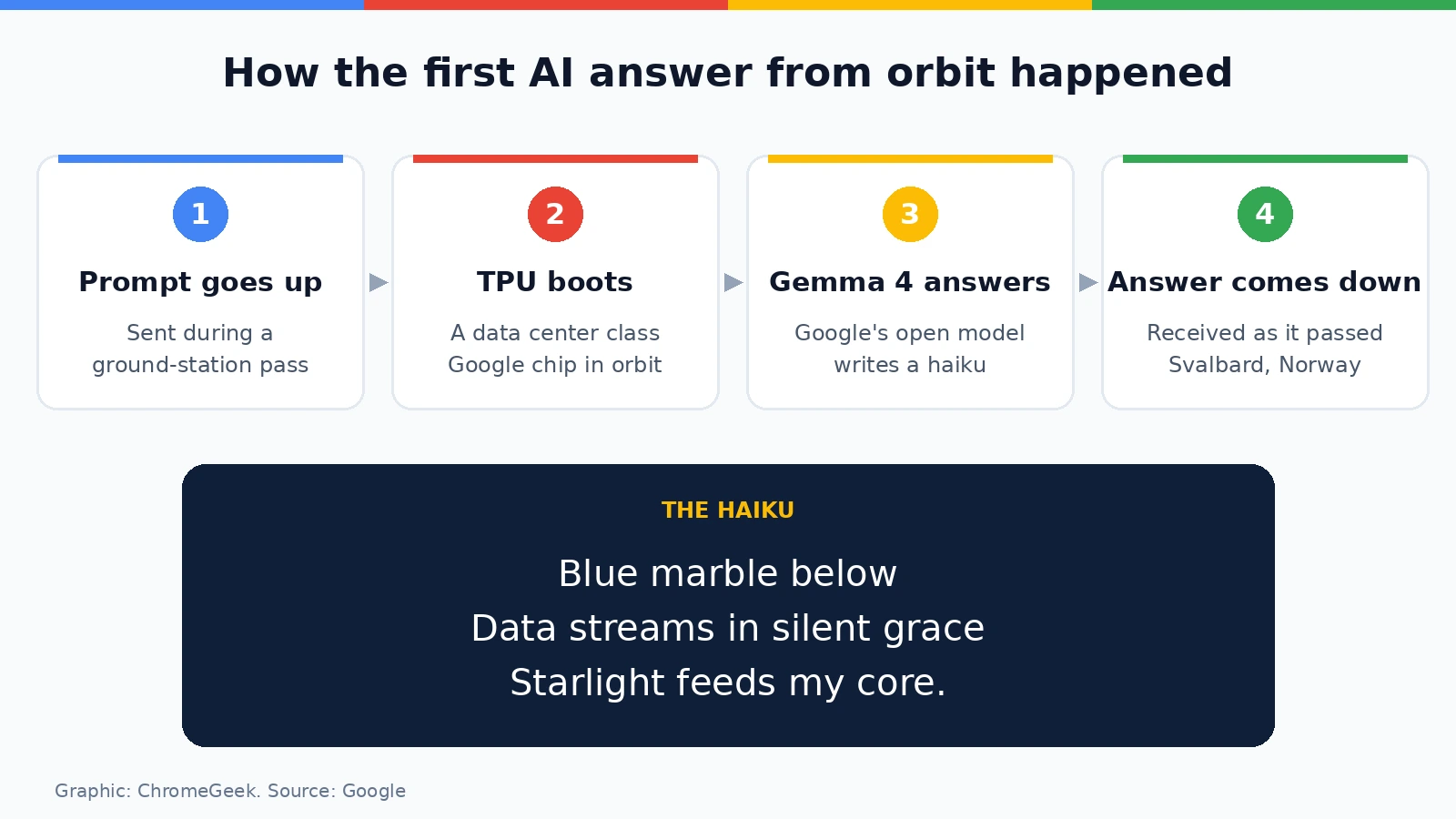
Why it matters: sending a prompt up, running it on an AI chip in space and getting the full answer back proves the basic setup works. It is a small job, but every bigger plan for Suncatcher depends on this step working first.
2. The satellite in numbers
Power is the limit: because the TPU needs so much power, the satellite can only run one chip for short bursts, which makes timing tricky when commands and answers have to pass through a ground station.
3. What Google tests next
Heat and radiation: Google says the next tests will check how its TPUs perform under heat stress and radiation in orbit. Radiation in space can flip bits in memory and quietly corrupt data, so this is the real test of whether the chips can be trusted with serious work.
Two satellites in 2027: if the chips hold up, Google’s next milestone is a pair of satellites linked together in 2027. The long-term idea behind Project Suncatcher is to power AI computing with solar energy in space.
Our take
A haiku sounds like a gimmick, but this is the AI version of a first phone call: it shows the whole chain works, from Earth to orbit and back. Nothing here changes your Chromebook today. Still, it is the same Gemma 4 family you can already run locally on a Chromebook, now running on a satellite, and that is a fun reminder of how far Google is pushing its AI chips.
You can also catch up on Gemini 4 Carbon, Google’s new top model and Genie 4, Google’s real-time AI worlds.
Discover more from Chrome Geek
Subscribe to get the latest posts sent to your email.